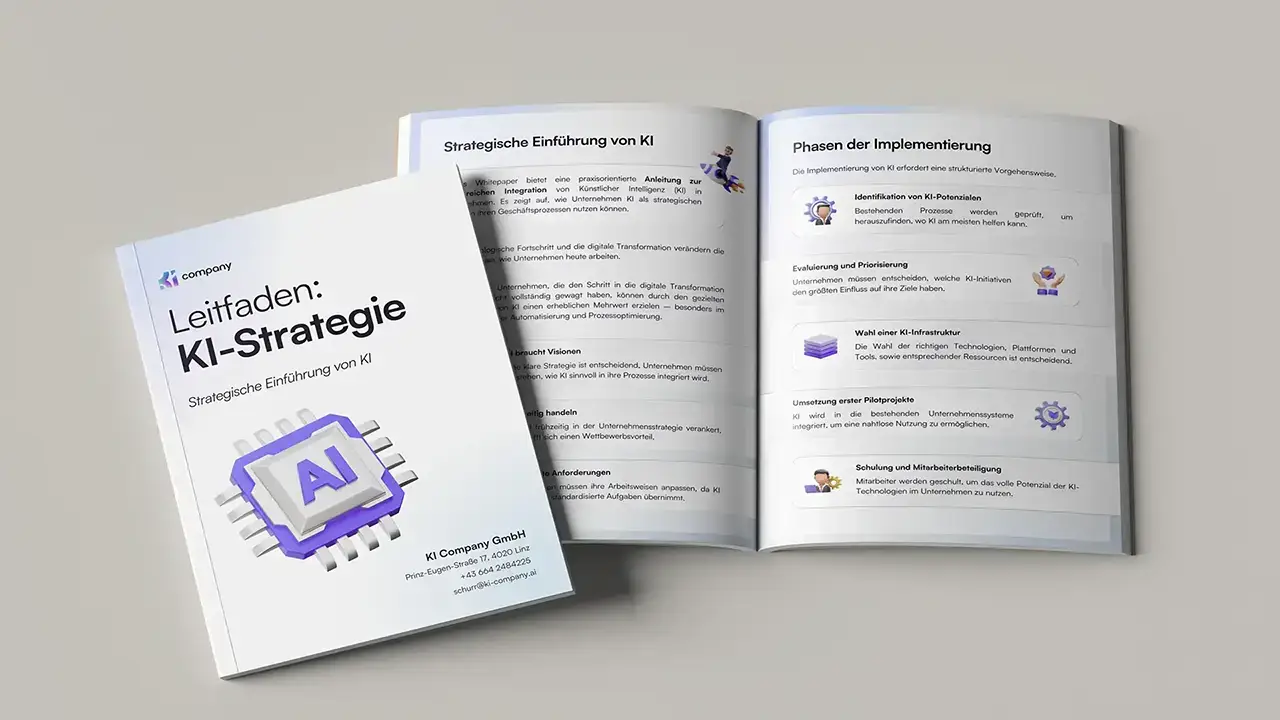
AI in administration describes the use of artificial intelligence in back office and administrative areas — such as in accounting, HR, office management, assistance or general administration teams. Many of these tasks are repetitive, rule-based and document-heavy — exactly where AI can save a particularly large amount of time and effort in administration 2026.
- for document processing & audit
- for automatic logging & meeting notes
- for email and inbox control
- for workflow, approval, and ticket automation
- for HR and employee administration
This is shifting the role of administrative teams: away from manual data collection and document search, towards control, quality assurance and communication. AI in administration is taking over routines — people are more concerned about exceptions, service quality and process improvements.
AI in administration: What exactly can be automated?
In practice, AI in administration is usually understood as a combination of three components:
- Recognize and understand content (text, numbers, speech, images)
- Decide based on rules and patterns (e.g. “which process, which folder, which priority? “)
- Carrying out follow-up actions (filing, notifying, initiating a workflow)
Typical candidates are therefore jobs with many documents, forms, emails or recurring process steps. Studies and market overviews show that areas such as invoice processing, data maintenance, HR administration and meeting organization in particular benefit greatly from automation and achieve significant time and cost effects.
From an employee's point of view, it's important: AI in administration does not replace the entire role, but takes on subtasks. This relieves routine tasks — at the same time, new tasks arise in managing, communicating, monitoring and improving automated processes.

Document processing and AI management
A classic area of application for AI in administration is document processing — particularly for invoices, contracts and forms. Modern systems go well beyond simple OCR and combine document recognition, data extraction and automatic allocation.
For incoming invoices, AI in administration can:
- Recognize and read invoices from emails, portals, or scans
- extract relevant data (supplier, amount, IBAN, items, payment term)
- Automatically assign documents to the right client, cost center or project
- Prepare plausibility checks and reconciliations (order, delivery note, contract)
- Store correctly in the DMS or ERP and initiate a digital approval process
Practical reports show that companies can reduce processing times by 60-80% and significantly reduce error rates with AI-supported invoice processing. At the same time, costs per invoice are reduced and compliance risks due to duplicates or missing approvals are reduced.
In addition to invoices, similar patterns can be used for other types of documents — such as contracts, order confirmations, form applications or incoming letters, which are sorted into categories and transferred to the correct processes.
Automatic logging & meeting notes
Another area in which AI is massively relieving administration 2026 is the logging of meetings. AI-powered meeting assistants can automatically record and transcribe conversations and create structured minutes with decisions and to-dos.
Typical range of functions of such solutions:
- Real-time transcription of online or in-person meetings
- Speaker recognition and attribution of contributions to people
- Summaries by topic blocks (“Decisions”, “Open Points”, “Next Steps”)
- Extraction of specific tasks with responsibilities and deadlines
- Export to collaboration tools, ticket systems, or protocol templates
This turns log keeping from a time-consuming additional task to a predominantly automated process. Employees can focus more on the content of the meeting instead of taking notes.
AI in administration can be thought of even further here: In the future, digital assistants will not only be able to write notes, but will also be able to respond to questions in meetings (e.g., “When did we last decide? “) or point out pending tasks from previous meetings. The first solutions in this direction are already available.
Manage email and inbox efficiently
Administrative teams often spend a significant amount of time viewing, forwarding, and responding to emails and digital mail. AI in administration can act as an intelligent filter and sorter here.
Specific deployment scenarios:
- Automatic recognition of email types (e.g. invoices, applications, complaints, inquiries, internal information)
- Assignment to the right person, department, or queue
- Generate drafts for standard answers, which are reviewed and approved by employees
- Recognition of deadlines (e.g. for administrative mail or legally relevant letters) and automatic setting of reminders
- Tagging and storing attachments in the right place (e.g. DMS, transaction file)
Here too, AI in administration does not take over the final communication in sensitive cases, but prepares, sorts and accelerates. In the future, standard inquiries can be more automated, while complex topics can continue to be handled personally.
Automate workflows, approvals & tickets
In addition to individual documents or emails, AI can support entire administrative workflows — such as vacation requests, order approvals, travel expense processes or internal service tickets. In many cases, classic workflow and RPA systems can be combined with AI (“hyperautomation”).
Possible fields of application:
- Automatic recognition of which process fits a process (e.g. “travel expenses”, “IT ticket”, “procurement request”)
- Prefill forms and system fields with read out data
- Suggest responsible approvers based on role, amount, or location
- Monitoring SLA times and escalating in case of delays
- Combine information from multiple systems for a holistic case view
Analyses show that many back office processes in IT, finance and HR can save 30—40% of manual processing time through AI-based automation if processes are sufficiently standardized. AI in administration plays the role of an “orchestrator”, which distributes data flows and tasks in a meaningful way.
HR, employee and contract management
HR and employee administration also includes many recurring tasks: onboarding checklists, contract versions, certificates, master data maintenance, absences, training records. AI in administration can act as an assistant in these areas.
examples:
- Reading and reconciliation of personal documents (contracts, certificates, proofs)
- Preparation of drafts for standard letters (certificates, contract supplements, reminders)
- Automatic update of master data in multiple systems after a change
- Assistance in creating job descriptions or onboarding documents
- Structuring and tagging employee documents in the DMS
AI works in a similar way in administration for contract management: It helps to monitor deadlines, identify clauses (e.g. termination or price change clauses) and compare contract versions. Legal evaluation remains with experts — but the preparatory work is significantly accelerated.

AI in Administration: Introduction, Quality & Change Management
For AI to really add value to administration, tools alone are not enough. Data quality, clear processes and active change management are decisive for success.
Key success factors:
- Process analysis in advance: Where are really repetitive, rule-based tasks — and where are exceptions the rule?
- Data and document quality: Uniform templates, consistent field contents, clean file structures
- Clear roles: Who is responsible for AI-supported processes, who checks results, who is allowed to make adjustments?
- Staff training: How do the new workflows work, where do you remain responsible, how do you report errors?
Studies and practical reports show that companies that see AI and automation as a strategic issue and actively involve their employees see significantly higher acceptance and productivity gains than those that only introduce tools selectively. AI in administration is therefore just as much an organizational as a technology issue.
AI in Administration: Common Questions (FAQ)
Which tasks are particularly suitable for AI in administration?
Repetitive, data-driven tasks with clear rules and lots of documents or emails are well suited — such as invoice processing, master data maintenance, standard confirmations, logging, simple evaluations or the pre-sorting of processes. Unique, very complex or heavily politically oriented topics that focus on context and interpersonal relationships are less suitable.
Will AI replace jobs in administration?
Current analyses suggest that AI in administration is primarily changing tasks, not replacing entire roles. A large portion of time can be shifted from manual recording and control to higher-value activities such as coordination, communication, and exception management. In the long term, job profiles are changing towards process management and service orientation — a planned development of competencies is therefore important.
How do I start pragmatically with AI in administration?
A pragmatic start comprises three steps: First, select one or two clearly defined use cases (e.g. incoming invoices, meeting minutes), secondly, test with existing systems and pilot areas, and thirdly define key figures (processing time, error rate, satisfaction). It is important to start small, learn quickly and roll out successful approaches step by step.
What are the risks of using AI in administration?
Risks relate primarily to data quality, data protection, misclassifications and lack of transparency. If documents are assigned incorrectly or deadlines are overlooked, this can have consequences. This can be counteracted with well-defined control points, role concepts, technical guard rails and careful introduction.
Do you need specialized IT skills to use AI in administration?
Many modern solutions are designed in such a way that specialist departments can operate them (“no-code/low-code”). Technical expertise is particularly important when it comes to integration, security, and architecture. Process understanding, accuracy and a basic understanding of AI functions are more relevant for ongoing operations — these competencies can be developed in a targeted manner through training.
AI in Administration: Conclusion and Outlook
AI in administration 2026 offers concrete levers to automate recurring tasks and noticeably relieve administrative teams. Whether document processing, logging, email control, workflow automation or HR administration: Wherever information needs to be structured, checked, forwarded and stored, AI can provide support as a digital co-pilot.
In administration, it is important not to regard AI as a unique tool project, but as a continuous improvement process. With every automated step, teams gain time to optimize processes, increase service quality and strengthen collaboration with specialist areas.
The KI Company helps organizations identify suitable use cases for AI in administration, set up pilot projects and securely integrate them into existing system landscapes — from invoice processing to meeting automation to HR and service processes. If you would like to check which administrative tasks can be automated first in your company, you can contact us at any time without obligation.