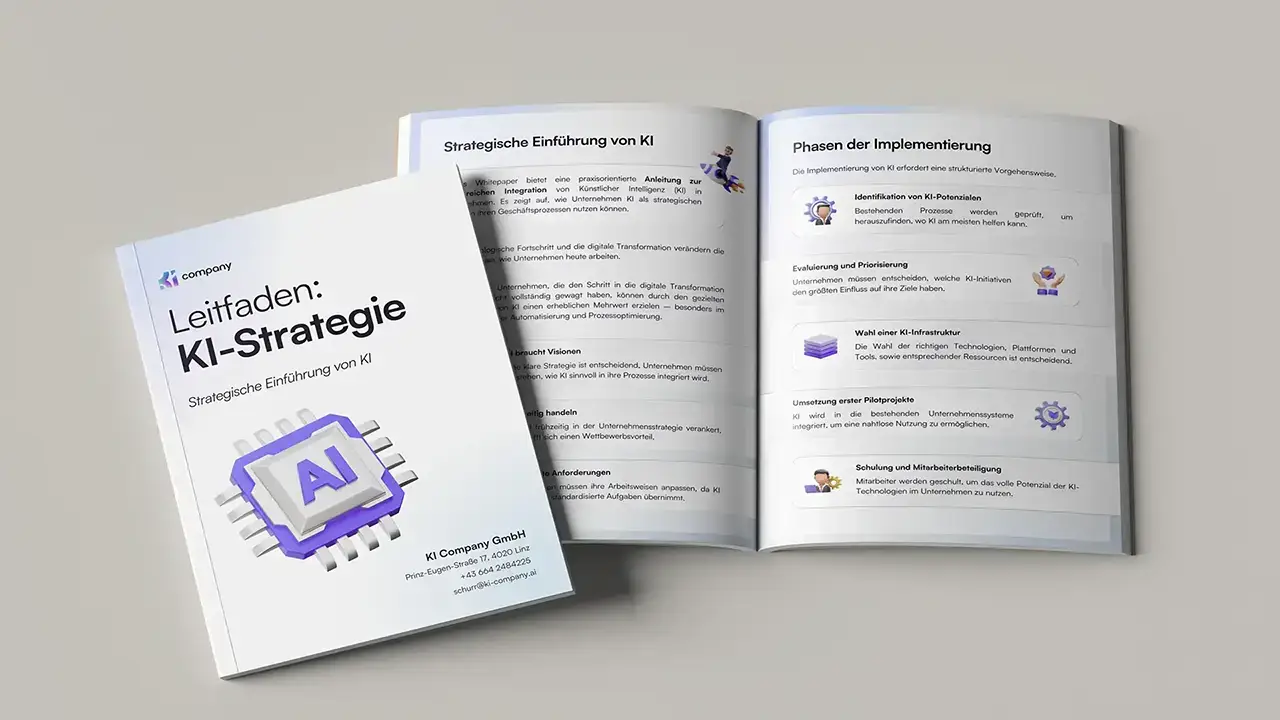
AI in customer service describes the use of artificial intelligence along the entire service processes — from inquiries via e-mail or chat to telephone calls in the contact center. In 2026, AI in customer service is expanding from initial pilot projects: Support teams are increasingly relying on automation to respond more quickly, be available around the clock and relieve employees of routine tasks.
- AI chatbot on your own website as the first point of contact
- AI in email inboxes for sorting, prioritization, and suggested answers
- AI telephone assistant in customer service to relieve the hotline
Companies hope that this will result in shorter waiting times, fewer standard requests for human agents and a more consistent service quality — while reducing costs at the same time. Studies already show that many contact centers use AI in customer service to automatically answer inquiries, classify tickets, and support voice dialogs.
AI in customer service: Why 2026 is so important
Customer service expectations are increasing significantly: Customers want quick answers, availability even outside office hours and as few referrals as possible. At the same time, service departments are under cost pressure, struggling with high fluctuation and a demanding recruiting market. AI in customer service offers a lever here to improve quality and efficiency at the same time.
Current surveys show that a high proportion of support teams are already using or planning to use AI in customer service — for example for chatbots, voicebots and automated response suggestions. The option of being available 24/7 and resolving standard inquiries more quickly is mentioned particularly frequently.
The right vision is important here: AI in customer service should not replace human employees, but support them. Complex cases, emotional situations and negotiations remain the responsibility of humans. In particular, AI takes care of pre-sorting, answering simple questions and documentation — and thus creates time for real customer relationships.

Possible use 1: Chatbots on your own website
An AI chatbot on your own website is often the first visible step towards AI in customer service. Modern, generative chatbots understand entire sentences instead of just keywords, can maintain context across multiple messages and access corporate knowledge — such as FAQs, help centers, product data, or internal knowledge databases.
Typical uses of AI chatbots in customer service:
- Answering recurring standard questions (password, shipping, returns, opening hours, etc.)
- Support in product selection, e.g. through inquiries and recommendations
- Status queries about orders, tickets, or contracts
- First problem analysis (“triaging”) before handing over to a human agent
- Gather relevant information (customer number, product, problem) before handover
Studies show that AI in customer service can reduce response times and reliably intercept simple inquiries through chatbots in particular. At the same time, satisfaction depends heavily on how well the bot is integrated, what knowledge base it has and how transparently the use of AI is handled.
Success factors for AI chatbots in customer service
For AI to really deliver added value in customer service with chatbots, a few points are crucial:
- Clear use cases: The bot should take on clearly defined tasks instead of “doing everything a bit.”
- Good knowledge base: Content must be up to date, consistent, and structured.
- Clean escalation: Customers must be able to easily switch to a person at any time.
- Tonality & brand voice: Answers should match the brand and target group.
Monitoring and training are also important: Chatbot dialogs should be evaluated regularly in order to close gaps in the knowledge base and improve wording. AI in customer service is not a “one-time project,” but a continuous improvement process.
Limits and risks of chatbots
AI chatbots aren't a panacea. Misconfigured bots that don't understand questions, send customers into loops, or don't offer a meaningful handover increase frustration instead of satisfaction. In addition, surveys show that many customers continue to prefer human contacts when it comes to complex or sensitive issues. Honest communication (“You are currently chatting with an AI assistant”) and clear rules as to when to hand over to people are therefore central components of professional AI in customer service.
Application 2: AI in email inboxes
In addition to web chat, the mailbox is an ideal place to make AI productive in customer service. Many companies receive hundreds or thousands of emails every day — from simple inquiries to complex complaints. Generative AI can help you pre-sort, prioritize and write suggested answers.
Typical functions of AI in customer service in the email channel:
- Classification: Automatic recognition of types of inquiries (e.g. order, technical question, complaint, withdrawal).
- Prioritize: Assessment of urgency, e.g. in the case of escalations or deadline issues.
- Routing: Assignment to responsible teams or people (e.g. accounting, engineering, sales).
- Suggested answers: Draft email responses that employees review and adapt.
- Sentiment analysis: Recognize the mood (neutral, angry, positive) for better processing.
Practical examples show that AI in customer service can significantly reduce email processing times because agents spend less time sorting and wording and focus more on the content solution.
What the ideal email workflow looks like with AI in customer service
A well-set up workflow could look like this:
- Receipt of the email in the central mailbox.
- AI in customer service analyses subject, content, attachments and recognizes type & urgency.
- Automatic allocation to the right queue/team.
- Generation of a draft answer including linking to relevant help pages or data from the CRM.
- Employees review, supplement and personalize the answer — especially in critical cases.
- Dispatch, logging in the ticket system and, if necessary, automatic creation of follow-up tasks.
It is important here to define clear rules as to which emails can be answered fully automatically (e.g. simple confirmations) and which always require human verification. In this way, AI in customer service remains controllable without sacrificing efficiency gains.
Quality and data protection aspects
Data protection and information security play a central role when using AI in customer service in the email sector. E-mails often contain personal data or confidential information. Companies should therefore:
- only use AI solutions that are operated in compliance with GDPR,
- define clear storage and deletion concepts,
- and train employees what content they can input into AI systems.
In addition, a four-eyes principle is recommended for sensitive issues — such as legal disputes or sensitive health data, depending on the sector.

Use 3: AI telephone assistant in the contact center
The AI telephone assistant is the third central use of AI in customer service. In contrast to classic voice menus (“Press 1 for...”), modern voicebots work with natural language: Customers describe their concerns freely, the AI understands intent and relevant details and guides through the dialogue.
In customer service, voicebots can, among other things:
- Fully automated processing of standard requests (e.g. account balance, shipment tracking, PIN blocking)
- Authenticate customers and pre-qualify relevant data before a person takes over
- Reduce wait times by querying information while an agent is being switched on in the background
- Record call reasons in a structured way and import them into ticket systems or CRMs
- Automatically generate summaries and notes after the conversation
Analyses show that voice AI in call centers can reduce processing times by 30-50% and handle a relevant proportion of calls automatically — while increasing accessibility.
Combining humans and AI on the phone in a meaningful way
AI in customer service shouldn't try to solve everything by itself over the phone. A combination is better:
- AI as a first instance, which recognizes concerns, solves simple issues and prepares more complex cases.
- Human agents, which take over complex, emotional or critical issues.
- Supporting AI in the background, which provides the agent with information, suggestions and checklists during the conversation.
The result is a hybrid approach in which AI reduces bottlenecks in customer service, but the human component is retained — especially in moments when empathy is crucial.
Success factors for AI phone assistants
For the successful use of AI in customer service via telephone, the following are important:
- Clean voice recognition (including dialects, accents, technical terms)
- Klare fallback strategiesWhen the AI doesn't understand something
- transparents pointersthat an AI system is in use
- Continuous training based on real conversations
- acceptance for employees who see voice AI not as competition but as support
Used correctly, an AI telephone assistant can relieve both customers and employees — but if configured incorrectly, it can generate frustration. A careful introduction is therefore essential.
AI in customer service: Common questions (FAQ)
Is AI in customer service only for large companies?
No Many solutions for AI in customer service are now available as cloud services and can also be used in smaller organizations. Chatbots on websites or email automation in particular can be introduced gradually — for example, initially for a limited subject area or a language. Clear prioritization is decisive, not the size of the company.
Is AI replacing human service teams in customer service?
Recent studies show that customers continue to place great value on human contacts — particularly when it comes to complex or emotional concerns. AI in customer service is particularly suitable for standard inquiries, pre-qualification and background support. In practice, the role of employees is shifting: less routine, more advice, more problem solving.
How do I get off to a good start with AI in customer service?
A pragmatic approach is to select a clearly defined use case — for example, an AI chatbot for FAQs, an email classification, or a simple voicebot for status queries. Objectives are then defined (response time, accessibility, cost savings), a pilot phase is carried out and key figures are closely monitored. If successful, AI in customer service can be extended to other areas step by step.
What are the risks of using AI in customer service?
Risks include incorrect or incomplete answers, data protection, lack of transparency, and potential frustration when AI acts too rigidly. This can be addressed through a good knowledge base, clear escalation paths to human agents, regular quality checks and a data protection-compliant architecture. Governance and training are central components of a responsible introduction of AI in customer service.
How do I measure the success of AI in customer service?
Useful indicators include initial resolution rate, average response time, processing time per request, referral rate to human agents, customer satisfaction (CSAT/NPS) and ticket volume. In addition, qualitative feedback from customers and employees should be included — for example on comprehensibility, usefulness and perceived relief. AI in customer service is successful when both customer experience and internal efficiency benefit measurably.
AI in customer service: Conclusion and outlook
With chatbots, email automation and AI telephone assistants, AI in customer service offers three very specific applications that can already be used productively today. They help automate standard inquiries, reduce waiting times and relieve employees of routine tasks. At the same time, the role of human agents remains central — particularly when it comes to complex, individual or emotional concerns.
Now is the right time for companies to develop a clear roadmap for AI in customer service: Which use cases bring the greatest benefit, which data and systems are needed, how are teams involved and how are risks addressed? Anyone who introduces AI to customer service in a structured way creates the basis for a service that is both efficient and customer-oriented.
The KI Company helps organizations identify suitable applications for AI in customer service, set up pilot projects and integrate solutions into existing system landscapes — from the website to the e-mail inbox to the contact center. If you would like to check which of the top three deployment options has the greatest leverage for your company, you can contact us at any time without obligation.