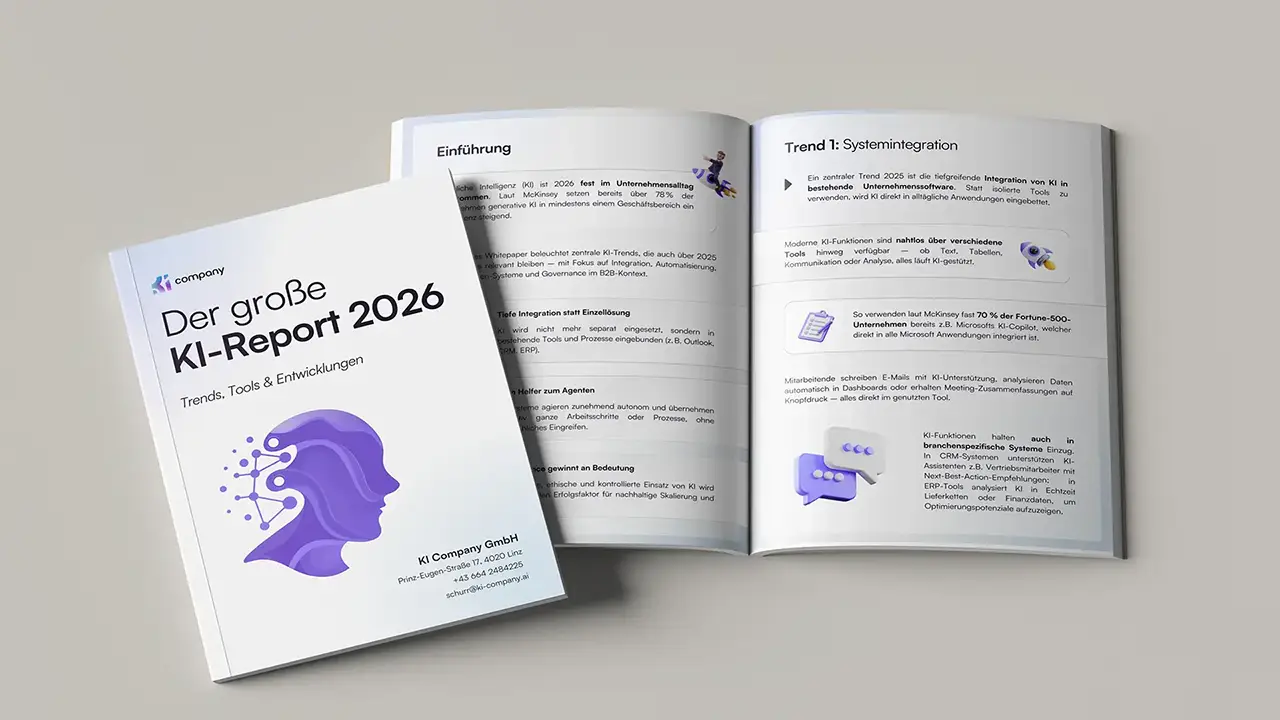
AI in marketing describes the use of artificial intelligence along the entire marketing value chain — from strategy and target group analysis to content creation, campaign management and media buying to attribution and reporting. In 2026, the focus is shifting significantly: away from selective tools to networked AI systems that orchestrate entire marketing processes and perform more and more tasks automatically.
For marketing managers, this means that AI in marketing is no longer an “add-on”, but a structural competitive factor. Anyone who aligns data, processes and competencies with this in good time can use the same or fewer resources to display more relevant content, budget more efficiently and measure what really works more reliably.
Trend 1: Content automation and scaling
The most visible trend in AI in marketing is automated content production. Generative AI models create texts, images, videos and even complete campaign assets and thus enable a hitherto barely achievable timing and variety of variants. It is estimated that by the middle of the decade, a large part of the online content will be created with at least AI-supported support.
For marketing teams, this means that instead of writing every email, every social post and every landing page from scratch, AI is used in marketing to create initial drafts, variants and localizations, which are then edited. In this way, significantly more content can be published without proportionally expanding the team.
Typical use cases for AI-supported content production
The trend is particularly strong in these areas:
- Blog articles, white papers and landing pages: AI creates draft versions, structural suggestions and variants
- Social media: generation of post texts, hook ideas, captions and hashtags at high frequency
- Performance Creatives: Variants of ad texts and visuals for A/B and multivariate testing
- Email marketing: subject lines, snippets, and personalized text modules for segment campaigns
- SEO content: Drafts for cluster pages, FAQs, and snippets based on keyword and intent analysis
A clearly defined approval process is important here: AI in marketing provides suggestions, but tonality, fact-checking and final approval remain with humans.
Processes, quality assurance and roles
As content automation increases, roles within the marketing team are shifting:
- Content managers become “editor-in-chief” for AI-generated content
- Prompt design and content briefings are becoming key competencies
- Guidelines for tonality, style, wording and no-gos are becoming more binding
- Quality assurance, brand fit and fact-checking remain central human tasks
Anyone who wants to successfully use AI in marketing therefore needs not only tools, but also clear processes, training and guidelines on how human and AI work intertwine.

Trend 2: Hyper-personalization and predictive journeys
A second key trend is hyper-personalization. AI in marketing uses vast amounts of behavioral, transactional, and contextual data to adapt customer journeys in real time — from the initial ad to the existing customer program.
Instead of just using simple segments (“new customer”, “existing customer”), AI is used in marketing to identify patterns: Which content converts for which persona? In which order should touchpoints be played out? Which channel is most effective for whom and at what point in time?
Personalization along the entire customer journey
Typical fields of application of AI in marketing in this area:
- Website & app: individual home pages, product recommendations and dynamic navigation
- Email & marketing automation: trigger-based routes that take behavior and interests into account
- Paid media: Dynamic creatives (text/picture/video) that tailor messages to target group clusters
- Onsite search: AI-powered search that takes into account synonyms, context and purchase probability
The aim is not to make everything appear as individualized as possible, but to prioritize the relevant content. Used correctly in marketing, AI ensures that users experience less friction and find suitable offers more quickly.
Predictive campaigning and next-best action
In addition, AI in marketing is adding forecasts to personalization:
- Churn probability: Which customers are threatening to drop out — and how can you counteract this?
- Purchase probability: Which leads have a high chance of closing — and when is the right time?
- Next best action: Which next step (email, call, voucher, content piece) makes the most sense?
Such forecasts are increasingly automatically fed back into campaign tools, so that not only reporting but also activation is based on data.
Trend 3: Campaign automation and media optimization
Beyond the content level, AI in marketing is increasingly automating the entire campaign orchestration. Modern systems take care of parts of media planning, budget distribution and ongoing optimization — in some cases up to AI agents who independently create, test and evaluate campaigns.
Instead of creating each ad manually and moving budgets manually, rules and goals are defined. AI in marketing uses historical results, real-time performance, and external signals (such as seasonality) to test variants and direct resources to the most effective measures.
From smart bidding to agentic marketing systems
Many platform functions are already AI-based today, such as:
- Smart bidding and budget automation in search and social channels
- Dynamic product and remarketing ads with automatically generated creatives
- Campaigns that independently control target ROAS or target CPA and up or down motivations
The next step is agentic systems that:
- Propose campaign drafts including target groups, creatives and channels based on goals
- Constantly test new variants and deactivate non-performing elements
- Simulate scenarios (e.g. “What happens if we shift budget by 20%? “)
Role of the marketing team in AI-powered orchestration
As automation increases, the role of “hands-on optimizer” is shifting to:
- Strategic goal definition and prioritization of target groups
- Controlling and interpreting AI recommendations in marketing
- Ensuring brand fit, creative quality and legal compliance
- Setting guardrails (e.g. maximum frequency, exclusion of sensitive environments)
AI in marketing does routine work — but strategy, storytelling and brand management clearly remain human responsibilities.
Trend 4: Attribution and performance measurement with AI in marketing
In parallel with automation and personalization, AI in marketing is also changing the way success is measured. In an increasingly cookie-free and privacy-oriented environment, classic multi-touch attribution and simple last-click models are reaching their limits.
AI-based attribution combines modelling techniques such as marketing mix modelling, incrementality tests and probabilistic models with machine learning to make impact relationships visible even without personal third-party cookies.
AI attribution in a privacy-first environment
Typical components of a modern measurement architecture:
- Aggregated data instead of individual tracking paths
- Model-based estimation of channel and campaign contributions
- High-frequency updating of models to identify market changes more quickly
- Combining experimental approaches (e.g. geo-testing) with continuous modelling
AI in marketing helps identify patterns in this data and make better budget decisions — without relying on invasive tracking methods.
From reporting to decision support
While many teams today still invest large amounts of time in reporting, AI in marketing is shifting the focus to interpretation and decision-making:
- Automatic dashboards and alerts in case of deviations from target values
- simulations (“what-if” analyses) for budget and scenario planning
- Recommendations for budget shifts between channels and campaigns
This makes performance measurement less backwards and more of a continuous management tool.

Trend 5: Governance, Ethics, and Content Authenticity
The more AI is used in marketing, the more important governance, ethics, and transparency become. Brands must ensure that AI-controlled content is brand-compliant, legally clean and in line with their own values. At the same time, customer sensitivity to deepfakes, disinformation and “content slop” is growing.
AI in marketing is therefore in an area of tension: On the one hand, efficiency and scaling, on the other hand, responsibility towards society, customers and employees.
Guidelines, roles, and approval processes
Proven governance measures include:
- Clear guidelines for what AI can be used in marketing — and what not
- Defined approval processes for AI-generated content, particularly for sensitive topics
- Training for marketing teams on opportunities, risks and legal frameworks
- Documentation of prompts, sources, and decision logics for traceability
Especially in regulated industries (e.g. finance, healthcare), a structured governance model is crucial for using AI responsibly in marketing.
Ensuring authenticity and brand experience
At the same time, the topic of authenticity is coming into focus:
- Real people, real stories and UGC remain highly important for brand trust
- Labeling AI content can help create transparency
- Creative guidelines should define how AI assets are combined with real elements
The aim is not to replace human creativity, but to usefully complement it with AI in marketing — while keeping the brand experience consistent and credible.
AI in Marketing: Common Questions (FAQ)
What does “AI in marketing” actually mean?
AI in marketing comprises all applications of artificial intelligence that support or automate marketing processes: from target group analyses, content creation and personalization to campaign management, bidding and media optimization to attribution, forecasting and reporting.
Does AI in marketing mean that creatives are becoming superfluous?
No AI in marketing primarily performs repetitive, varied and data-intensive tasks. Creative work is changing but remains central: Briefings, storytelling, brand positioning, visual guiding ideas and final quality assurance continue to require human expertise. In many teams, the focus is shifting from “writing yourself” to “curating, managing and refining.”
From what size of company is AI worthwhile in marketing?
AI in marketing can already be worthwhile for smaller teams — for example through support in content creation or simple automation in the email and social media sector. As channels, budgets and target groups become more complex, efficiency gains are significantly increasing. It is important to start with clearly defined use cases in a focused manner instead of introducing “all tools at once.”
What skills will marketers need to use AI in the future?
Key competencies include data understanding, prompting, systemic thinking, and the ability to critically question AI recommendations. At the same time, classic marketing skills — customer insight, positioning, creativity — remain essential. AI in marketing amplifies the impact of these skills, but does not replace them.
How can the success of AI in marketing be measured?
Performance measurement should take into account both efficiency and effectiveness indicators: time savings in production, scaling of variants, performance improvements (e.g. CTR, conversion rate, ROAS), better budget allocation and qualitative indicators such as brand perception or customer satisfaction. It is important to define clear goals and measurement criteria in advance.
AI in marketing: Conclusion and outlook
AI in marketing is shifting the focus from manual execution to strategic control, orchestration, and quality assurance. Content automation enables higher publishing frequency, hyper-personalization increases relevance, campaign automation improves efficiency, modern attribution brings transparency to a complex environment, and governance ensures that all of this is done in line with brand and regulation.
For CMOs and marketing managers, this means that now is the right time to develop a clear roadmap for AI in marketing. This includes prioritizing use cases, building a reliable database, selecting suitable tools and qualifying teams.
The KI Company helps companies to introduce AI in marketing in a structured and practical way - from identifying relevant use cases to prototyping and pilot projects to integration into existing MarTech stacks. If you would like to evaluate which of the five trends are most relevant for your company, feel free to contact us without obligation via the KI Company website.