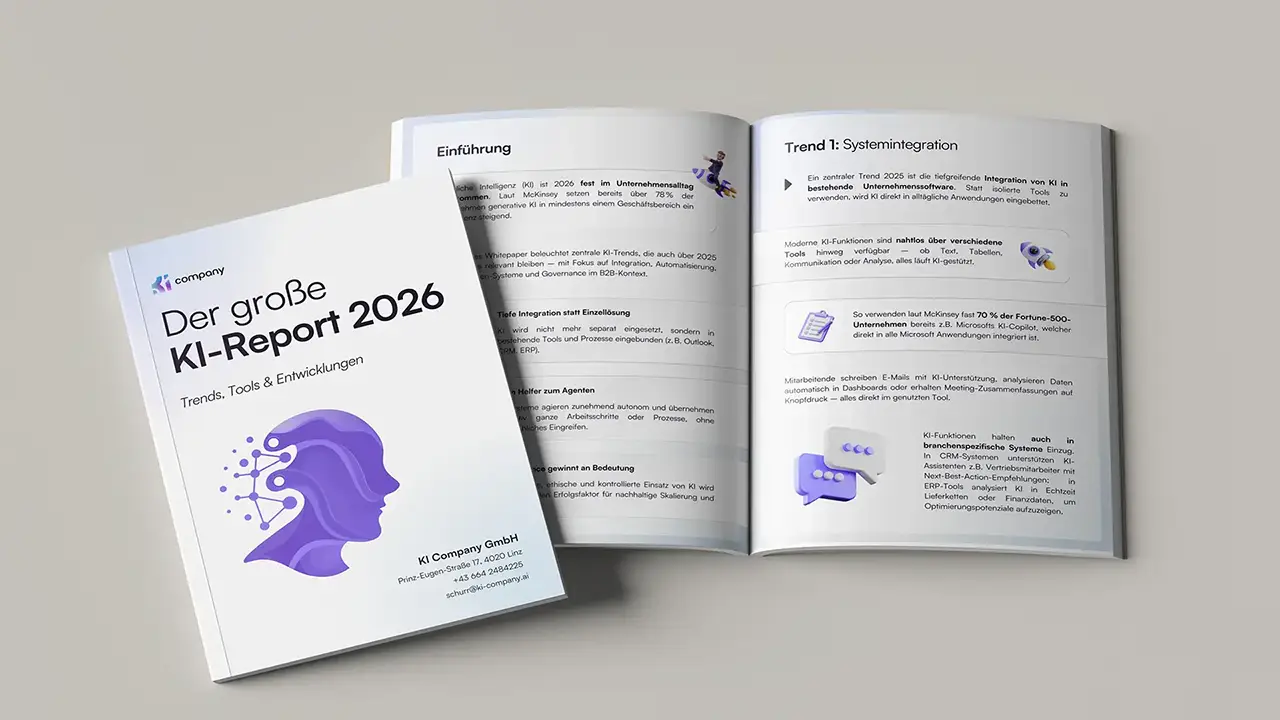
AI Trends 2026 show that artificial intelligence is out of the experimental phase and is becoming an integral part of the corporate strategy. According to recent studies, around three quarters of companies worldwide are already using AI, and more than 70% are working with generative AI - but often still in pilot projects and stand-alone solutions.
This article summarizes the most important AI trends in 2026, translates them into understandable language and uses practical examples to show where companies can actually start. Many of the developments reinforce each other: If you think about integration, data quality and governance early on, you can scale AI more securely and build up real competitive advantages.

AI Trends 2026: Why They're So Relevant Now
The major AI trends of 2026 can be summarized in three movements: wider use, higher autonomy and more regulation. Companies are no longer just using AI for selective efficiency gains, but are starting to rethink processes — from knowledge work to production planning.
At the same time, international surveys show that although many organizations are launching AI pilots, they are reaching limits when scaling: lack of data quality, unclear responsibilities or uncertainty surrounding the EU AI Act.
Anyone who wants to understand AI trends 2026 should therefore look at them not only technologically but also organizationally: Which roles do I need? Which database is necessary? And how do I ensure that AI fits into existing tools, processes, and compliance structures?
Trend 1: Deep integration into tools and processes
System integration in everyday work
One of the key AI trends in 2026 is seamless system integration. AI migrates from individual browser tabs directly to the tools in which employees work anyway — email, office suite, CRM, ERP, service desk. Modern Copilot solutions access company data and provide support right where decisions are made.
Practical examples:
- In Outlook or Gmail AI suggests draft answers, structures emails, and summarizes long threads.
- In Teams, Zoom, or Meet A meeting assistant automatically creates minutes, to-dos, and decision summaries.
- In CRM helps AI structure customer notes, plan next steps, and prioritize leads.
- In ERP AI analyses inventories, delivery times and ordering behavior in order to make suggestions for optimization.
For these AI trends to develop their potential in 2026, companies must connect their systems more closely, eliminate duplicates and define clear data flows. Otherwise, AI only produces “nicer texts” based on blurred data.
Industry integration: AI in specialized systems
In addition to horizontal tools, AI functions are increasingly being used in industry-specific platforms:
- In the industry MES and SCADA systems use AI to analyze scrap rates and recommend maintenance windows.
- In the financial sector support AI modules in fraud detection, risk assessments and customer segmentations.
- In healthcare AI assistance systems help to review findings without replacing medical decisions.
For companies, this means that the introduction of AI is no longer an IT side project, but part of application strategy. With every software decision, the question is: Which AI functions are integrated — or can be usefully added later?
Trend 2: Hyperautomation and end-to-end workflows
Among the AI trends 2026, the Hyperautomation out: It is no longer just about speeding up a work step, but entire End-to-end processes To run with AI-assisted operation.
Customer service case study:
- AI reads incoming emails or web forms, recognizes the issue and automatically creates tickets.
- An AI system assigns cases to the right queue, prioritizes according to urgency and suggests solution steps.
- In the case of clear standard cases (e.g. delivery delay, password reset), the AI solves the process completely itself — including an answer to customers and adjustment in the ERP.
Similar patterns can be seen in invoice processing, refunds, contract renewals, or onboarding processes. It is important that hyperautomation rule-based and remains transparent — with clear points where people can intervene.
For this AI trend 2026 to work, companies need: standardized processes, clean interfaces and clear definitions of which decisions can and cannot be automated.
Trend 3: Agentic AI and AI Agents
From assistant to acting agent
Another key trend is agentic AI: Systems that not only react to prompts, but also actively plan tasks, carry out intermediate steps and return results. Studies show that more than 60% of companies work with AI agents, at least experimentally.
Examples of agentic AI trends 2026:
- A marketing agent analyses campaigns, runs A/B tests independently, reallocates budgets and reports weekly.
- A Procurement agent monitors supplier risks, compares offers, creates order suggestions and accepts routine orders.
- A sales agent researches new leads, reads websites and press releases, recognizes buying signals and generates personalized outreach emails.
Control mechanisms and responsibility
With this 2026 AI trend, questions about Responsibility and control:
- Who is liable if an agent makes wrong decisions or crosses borders?
- How do we ensure that agents follow business rules and compliance?
- Which limits and “guardrails” are defined technically and organizationally?
Many companies therefore rely on “human-in-the-loop” model: Agents prepare decisions or only carry out defined sub-processes; critical steps remain the responsibility of humans. In parallel, monitoring and testing frameworks are being developed to observe and adjust agent behavior.
Trend 4: Personalization and data-driven customer experiences
Personalization has been one of the most important AI trends for years — it will take on new forms in 2026 thanks to generative AI and better integrated data. AI uses real-time information to deliver content, offers, and service experiences individually to play out.
Practical examples:
- In ecommerce Product texts and recommendations are dynamically tailored to the behavior and history of individual users.
- In financial sector Offers (e.g. savings plans, insurance modules) adapt to life situation and risk profile.
- In e-learning platforms AI generates individual learning paths, explains content at the appropriate level of difficulty and suggests repetitions.
High-quality, linked data is a prerequisite for this AI trend 2026. Companies with well-maintained CRM data, clear consents and modern data platforms can personalize much more specifically. Without a data strategy, personalization remains piecemeal.

Trend 5: Open-source AI and AI sovereignty
Open source models are clearly part of the AI trends 2026. They offer transparency, adaptability and — depending on the license — can be operated without ongoing model fees. At the same time, the desire of companies and states is growing AI sovereignty, i.e. the ability to control your own models or instances.
Specific developments:
- More and more powerful open-weight models are available, which can be fine-tuned on your own data.
- Large vendors combine proprietary and open models in hybrid stacks to prioritize flexibility or performance, depending on the use case.
- Companies are experimenting with local deployments (on-premise or private cloud) to keep sensitive data in your own environment.
At the same time, open-source AI cannot be taken for granted: licensing conditions are complex, it requires know-how for operation, security and monitoring. Many organizations therefore rely on platforms that abstract various models — open and proprietary — and make them manageable.
Trend 6: Governance, EU AI Act and AI Literacy
No overview of AI trends 2026 is complete without Governance. The EU AI Act has been in force since August 2024 and is gradually taking effect: Prohibited practices have been prohibited since February 2025, requirements for general-purpose models take effect from 2025, high-risk systems must comply with the full requirements by 2026/27 at the latest.
The Act also requires companies to AI Literacy: People who use or are affected by AI systems must be enabled to understand how they work and their limits. This is in line with an already growing need for training, guidelines and internal AI guidelines.
Typical governance components in companies:
- AI policy with clear rules as to which tools and data can be used.
- Processes for risk assessment, data protection impact assessment and approval of new use cases.
- Monitoring of models (quality, bias, drift) and defined intervention mechanisms.
- Training programs that empower employees to safely use AI.
Governance is therefore not an obstacle to innovation, but a necessary frameworkto responsibly scale AI trends in 2026.
AI Trends 2026: What companies should do now
So that AI trends 2026 don't just remain buzzwords, companies can take three pragmatic steps:
- Create a use case portfolio
- List of the most important pain points and potentials (e.g. time wasters, bottlenecks, quality issues).
- Prioritize based on benefit, feasibility, and risk.
- Create a technical and organizational framework
- Selection of 1-2 central AI platforms plus integrative tools in everyday work.
- Establishment of a small, interdisciplinary AI team (IT, specialist areas, data protection, law).
- Start pilot projects with clear KPIs
- Small, manageable projects (e.g. meeting minutes, email assistants, chatbots).
- Measurement of time savings, quality and user acceptance; scaling if successful.
In this way, AI trends 2026 will go from buzzword to measurable change in day-to-day business.
AI Trends 2026: FAQ for companies
Which AI trends in 2026 have the greatest immediate benefits?
In particular, bring in the short term Integration with Office tools, AI-powered communication (emails, logs) and Service automation (chatbots, ticket classification) measurable effects. Many companies are already seeing significant time savings per employee here, while more complex agent scenarios are still in pilot phases.
How much should I rely on open-source AI?
Open-source AI is one of the exciting AI trends of 2026, but it's not suitable for every scenario. For companies with high demands on data sovereignty and customization, a hybrid approach can be useful: proprietary models for standard tasks, open or proprietary models for particularly sensitive or specialized use cases. License clarity, operational expertise and a security concept are decisive.
Will agentic AI replace human workers?
The current AI trends 2026 are more likely to Role shift as a complete replacement. Agents take on routine and coordination tasks, while people retain responsibility for goal setting, interpretation, exceptional cases, and relationship development. Studies show that companies with a clearly defined interaction of people and AI get more value from agents than those who just want to “save personnel costs.”
What does the EU AI Act mean for me in practice?
It depends on your applications. There are general transparency and due diligence requirements for many “standard” use cases in office, marketing or internal knowledge work. High-risk systems — such as for credit checks, HR decisions or critical infrastructure — are subject to strict documentation, testing and governance requirements. Companies should clarify at an early stage which systems fall into which category and which deadlines apply.
AI Trends 2026: Conclusion and Outlook
AI trends 2026 clearly show: Artificial intelligence is evolving from a tool to Players in business processes. Deeply integrated features, hyperautomation, agentic AI, personalized experiences, open-source models, and governance frameworks combine to create a new operating system for organizations.
Anyone who develops a clear AI strategy at an early stage, anchors governance and starts practical use cases can use these developments instead of being surprised by them. Companies that systematically invest in AI in 2026 — technologically, organizationally and culturally — create the basis for remaining competitive over the next few years.
The KI Company supports organizations in deriving concrete projects from AI Trends 2026: from analyzing the initial situation and selecting suitable platforms to implementing pilots and scaling. If you would like to know which AI trends have the biggest leverage for your company, you can always contact us without obligation.