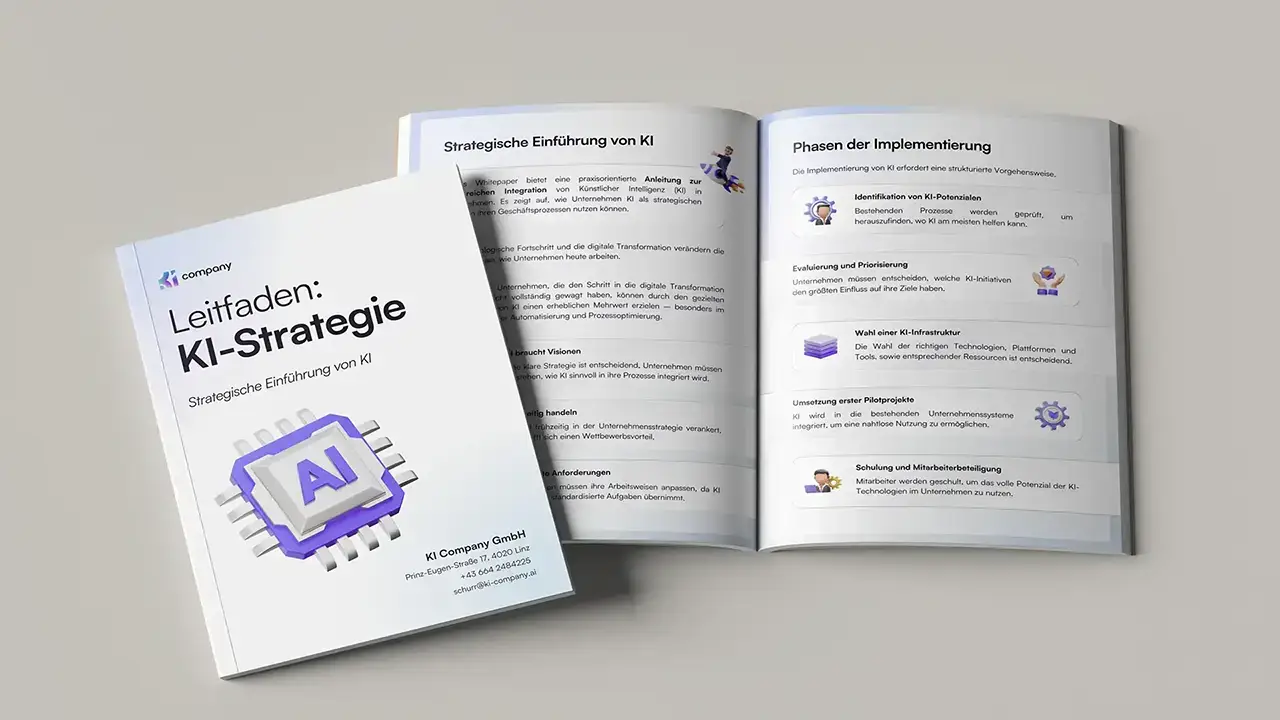
Strategic measures are the difference between “we're testing AI” and “we're achieving measurable benefits.” Generative AI in particular requires a clear, pragmatic approach: secure, prioritized and compatible with your existing processes.
To make this guideline work in practice, it is deliberately written “close to the company”: with specific decisions, typical stumbling blocks and a process that you can immediately use internally.
Strategic measures start with a clear vision
Strategic measures for AI do not start with tool selection, but with a target image: What should AI actually improve for you — time, quality, turnover, customer experience, compliance, knowledge transfer?
A good goal is short, measurable and can be connected across teams. An example: “We are reducing the turnaround time for offers by 25% while maintaining the same quality” or “We are reducing first-response times in support by 30%.”
It is important that the target image is not formulated as “AI-centered,” but as “business-centered.” AI is a means to an end — not the project goal.
When you have the target image, the next strategic measure becomes easier: Use cases are not “collected”, but selected and evaluated based on the target image.
Guardrails instead of bans
Without governance, shadow AI quickly emerges: Employees use AI tools inconsistently, upload data and build their own workflows — often without ill intent, but with risk.
One of the most important strategic measures is therefore a simple, understandable guardrail — preferably as an “AI traffic light”:
- green: approved tools & permitted data types (e.g. public marketing material)
- yellow: allowed with restrictions (e.g. only anonymized/ without customer data)
- red: taboo (e.g. personal data, confidential contracts, price lists)
The traffic light should not sound legal, but should be suitable for everyday use. Good governance reduces uncertainty and increases usage — because employees know what they can do.
At the same time, a clear distribution of roles is worthwhile: Who decides on tool approvals? Who is the owner of prompts/playbooks? Who is responsible for data protection and access rights?

Strategic measures for tool and platform selection
Many companies make the mistake of getting lost in feature comparisons. Strategic measures for tool selection should first answer the question: Is the setup secure and scalable?
Practical criteria that have proven effective:
- Single sign-on, roles & rights, admin controls
- Data processing: What is stored, what is used for training, what is not?
- Connectors: Which data sources can be connected (SharePoint, Drive, CRM)?
- Logging/audit: Can I understand who did what?
- Deployment options: cloud, EU regions, private options (as required)
Especially in the EU context, strategic platform selection measures should always be taken together with data protection/IT security, not as a “department buys tools” issue.
If you already make heavy use of Microsoft 365 or Google Workspace, the pragmatic path is common: Start where identity, rights and data rooms are already clean — and only then add special tools.
Fewer ideas, better prioritization
There are always lots of AI ideas. Strategic measures must therefore prioritize — and consistently.
A practical scoring model for use cases:
- Business Impact (time, quality, turnover, risk)
- feasibility (Data available? Processes clear? Interfaces available?)
- risk (data protection, legal consequences, reputation risk)
- acceptance (Do teams really use that in everyday life?)
- Time-to-value (First results possible in 2—6 weeks?)
Important: Don't start with the “most complicated, valuable” use case, but with the most valuable feasible. This creates momentum, trust, and learning curve.
Typical “starter” use cases (useful almost everywhere):
- Email and text drafts with clear data rules
- Meeting summaries & task lists (with suitable solution)
- Offering and presentation structuring
- Knowledge base: find faster, formulate better
- Support drafts with human review
This results in rapid success — and at the same time gives you input for the next strategic measures.
Strategic measures for data: quality, access and “AI readability”
Without data, there is no reliable AI. A key strategic measure is therefore to make your data landscape “AI-enabled” — pragmatic, not perfect.
Three levels that you should separate:
1) Knowledge data (documents, PDFs, guidelines, product information)
This is usually where the quickest benefit is possible: Search, summarize, answer questions — with a clean authorization model.
2) Process data (tickets, CRM notes, ERP information)
This is where real automations arise, but also higher risks: accesses, write rights, errors.
3) Sensitive data (personal, confidential, regulated)
Here, strategic measures need clear rules, masking/anonymization, and often separate environments.
Practically important: “AI readability” also means order. When information is stored in ten repositories, is contradictory, or without metadata, AI produces texts — but not reliable decisions.
Risk management: NIST AI RMF as a pragmatic grid
When it comes to AI risks, many companies only think of data protection. In reality, risk management is wider: bias, hallucinations, wrong decisions, lack of accountability, security, model drift.
The NIST AI Risk Management Framework with its core functions (Govern, Map, Measure, Manage) provides a helpful grid.
Here's how you can translate that into strategic measures:
- Govern: Responsibilities, policies, approval processes, monitoring
- Map: Where does AI work? Who is affected? Which data flows?
- Measure: Measure quality (e.g. accuracy, error rate, response time)
- Manage: Define measures (human-in-the-loop, guardrails, escalation)
Important: For many internal GenAI use cases, “reasonable care” is sufficient — but it must be documented. This saves discussions later when AI is rolled out more broadly.
Strategic compliance measures
In addition to internal risks, there are also regulatory requirements. A strategic measure that is becoming increasingly important: AI Literacy (AI expertise in the company). The EU underlines that organizations should ensure sufficient understanding among employees — depending on role and risk.
This is not an invitation to endless training programs. In practice, it is often enough:
- Basic training: What is AI, what are typical mistakes (hallucinations), which data rules apply?
- Role-specific modules: e.g. HR, Sales, Support, IT
- Short “do/don't” guides and internal prompt playbooks
- Regular office hours for real cases
This makes AI literacy a feasible strategic measure — and not a bureaucratic blocker.
From pilot to operation without frictional losses
Many AI initiatives fail not because of the pilot, but because of the transition to everyday life. Strategic measures must therefore build the “pilot → operation” bridge.
A tried and tested process:
1) Pilot with a clear hypothesis
Not “we're testing AI,” but “we expect 20% time savings in process X.”
2) Measurement and review
Quality, speed, acceptance, risks — with real examples, not just gut feeling.
3) Standardization
Prompt templates, checklists, quality criteria, defined data sources.
4) Rollout with enablement
Short trainings per team, use case demos, internal FAQ.
5) Operation & continuous improvement
Monitoring, feedback, updates, new versions of playbooks.
Management systems and standards also help as guidelines here — such as ISO/IEC 42001 as a framework for an AI management system (for organizations that want to manage AI in a structured and sustainable way).
AI becomes part of everyday life when leadership makes it possible
The introduction of AI is always also a change. One of the underrated strategic measures is cultural: creating psychological security.
In concrete terms, this means:
- Teams can ask questions without appearing “ignorant.”
- Mistakes in the pilot phase are learning material, not a career risk.
- AI is positioned as support — not as monitoring.
- Leadership uses AI visibly and responsibly (role model).
“AI champions” in each area are very effective — not as elites, but as contacts for real tasks. This lowers barriers to entry and prevents AI from “living” only in a small group.

Compact timetable: 10 points that help immediately
If you want to address the topic of AI in a company in a structured way, you can use these strategic measures as a checklist:
- Define target image (2-3 measurable goals)
- Publish AI traffic light & data rules
- Define approved platform (s) (including SSO & roles)
- Collect and score top 10 use cases
- Start 2-3 pilots with a clear hypothesis
- Prompt playbooks + create quality checks
- Conduct basic AI literacy training
- Establish monitoring & logging for productive use cases
- Pilot transition → Standardize operation
- Quarterly review: new use cases, risks, adjustments
This is deliberately pragmatic. Strategic measures should not slow down, but combine speed with safety.
Strategic measures FAQ: Frequently asked questions from companies
What are the most important strategic measures to get started?
A clear goal, an AI traffic light (governance), 2-3 prioritized use cases and a secure tool framework with roles/rights are usually the best start.
How do I prevent shadow AI without banning everything?
By providing secure, official alternatives, making rules understandable and quickly showing teams real benefits. Bans without an offer usually only lead to more secrecy.
Do we need an “AI Center of Excellence” right away?
Not necessarily. For many SMEs, a small core team (IT/security, department, data protection) plus clear ownership is enough. What is important is less the name, more the commitment.
How do we measure success?
With a few, clear KPIs per use case: time savings, error rate, turnaround time, customer satisfaction, costs per process — plus acceptance (usage rate).
How much training is “enough”?
As much as necessary for teams to work safely and effectively. In the EU context, AI literacy is explicitly emphasized — a basic module plus role-specific specialisation is therefore worthwhile.
Conclusion: AI will be successful when it becomes controllable
Strategic measures make AI controllable in companies: goals instead of tool hype, governance instead of wild growth, use case prioritization instead of flood of ideas, AI literacy instead of uncertainty.
When you set up your AI like this, it goes from an experiment to a skill: repeatable, measurable, and safe. This is exactly when sustainable benefits arise — not just individual “cool” results.
The KI Company will help you translate strategic measures into an implementable roadmap: from AI status analysis to use case workshops to governance, tool selection and team enablement. You can always contact us without obligation.