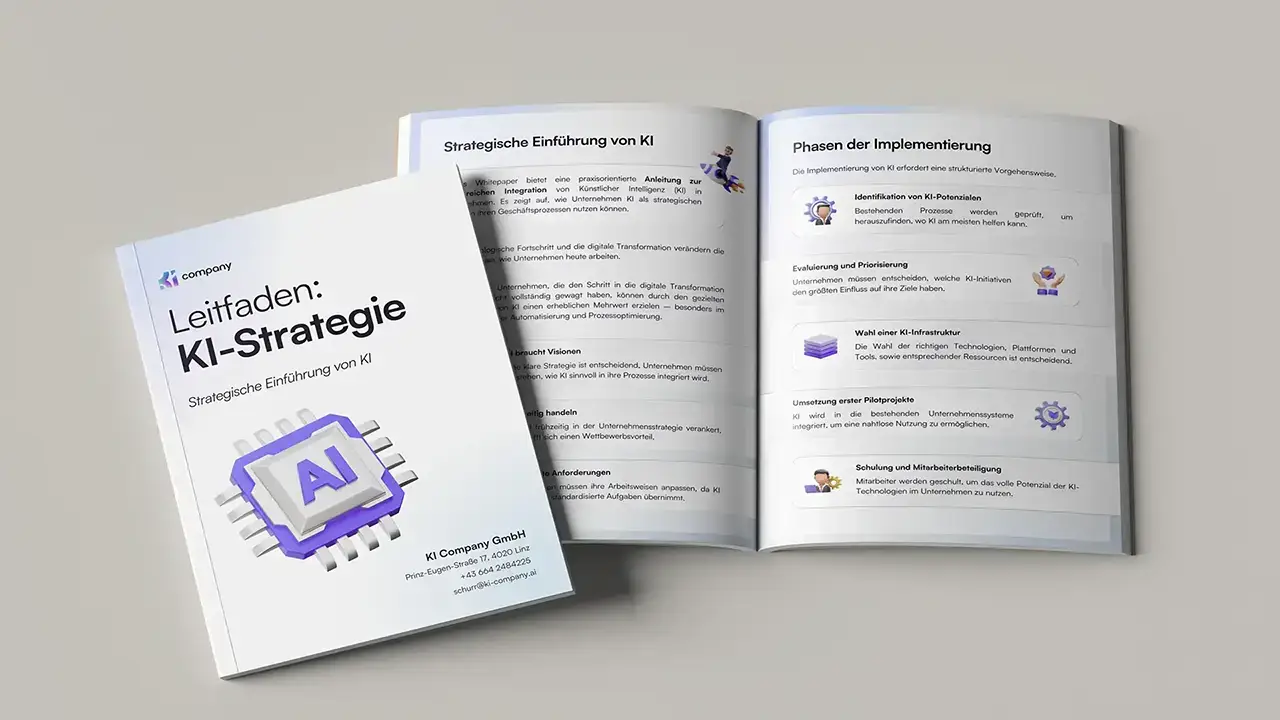
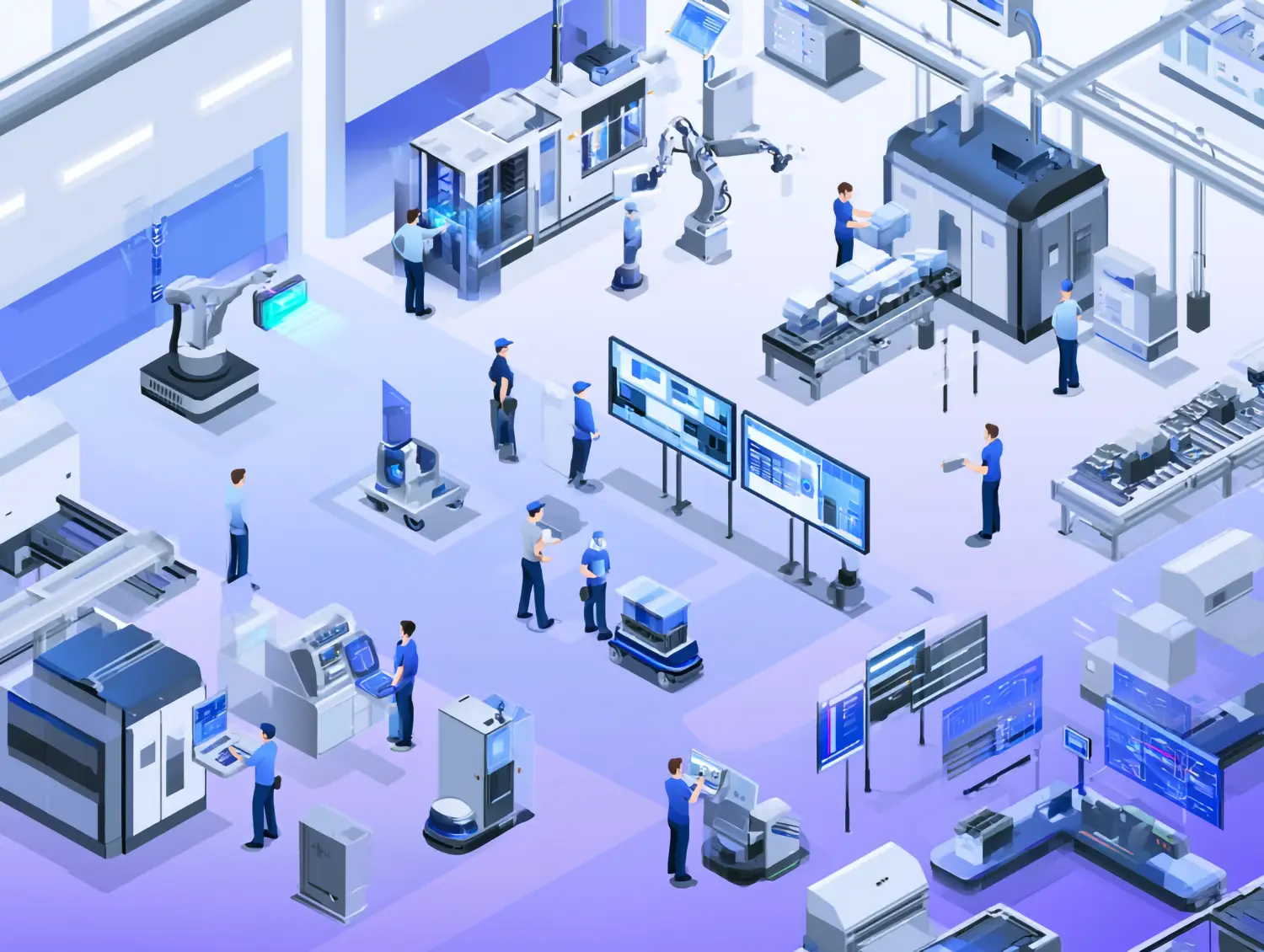
AI in industry is no longer just a topic for the future. It refers to the targeted application of artificial intelligence in production processes, machinery, quality control, planning, maintenance, and internal operations.
Industrial companies are currently facing several challenges:
- rising energy and material costs
- skilled labor shortages in production and maintenance
- intense competitive pressure
- complex supply chains
- increasing demands for quality and speed
- growing need for data-driven decisions
This is exactly where industrial AI can make a tangible contribution. Manufacturing plants already possess a wealth of valuable data: sensor data from machines, image data from quality inspections, order data from ERP systems, maintenance records, inventory information, and energy consumption metrics. AI helps to derive patterns, warning signals, and actionable recommendations from this data.
The crucial difference compared to traditional automation: AI does not need to be manually programmed for every single edge case. It can learn from existing data, detect anomalies, and provide suggestions that support employees in their daily work.
Key takeaways
AI in industry is most effective where large amounts of data are generated and quick decisions are required. This primarily concerns maintenance, quality control, production planning, supply chains, and energy consumption.
It is important to note: AI does not replace the expertise of skilled workers. It supports teams by making information available faster, identifying risks earlier, and automating recurring analyses.
However, many companies start too big or focus too much on the technical side. A more successful approach is a pragmatic start with clear use cases. The example article, which this post is structurally based on, demonstrates this exact logic: concrete use cases, understandable examples, and a clear roadmap for implementation.
For starters, five central areas of application are often sufficient. They provide a good overview of where AI can already be put to practical use in industry today.
AI in industry: Why its implementation is relevant now
The manufacturing industry is under high pressure to be efficient. Machines need to run without unplanned downtime, quality must remain consistently high, and delivery deadlines are becoming increasingly tight.
At the same time, vast amounts of data are generated daily that can hardly be fully evaluated manually. This is where AI can help: it analyzes sensor data, detects deviations, compares production patterns, and assists in prioritizing actions.
Fraunhofer describes predictive maintenance as a key approach where AI detects wear and tear to prevent machine failures ([Fraunhofer IIS](eas.iis.fraunhofer.de)).
This makes AI relevant for small and medium-sized industrial enterprises as well. It is not about automating the entire production process immediately. The key is to start with a clear problem and make the benefits measurable.

AI in Industry Use Case 1: Predictive Maintenance
Predictive maintenance is one of the most well-known use cases for AI in industry. It involves AI evaluating machine data to detect signs of wear before an actual failure occurs.
Typical data sources include vibration, temperature, power consumption, pressure, operating times, or error messages. The AI continuously analyzes these values and identifies patterns that may indicate a technical problem.
What AI can achieve in maintenance
AI can report unusual changes at an early stage. For example, if the vibration of a motor changes gradually, it could indicate an emerging bearing problem.
This makes maintenance more predictable. Instead of unplanned downtime, the maintenance team can intervene specifically when it is least disruptive to production.
Practical example from production
A manufacturer operates several CNC machines in a three-shift system. One machine shows slightly increasing temperature and vibration values over several days.
The AI recognizes that this combination has frequently occurred in the past before a spindle failure. It notifies the maintenance department of an increased risk and suggests checking the machine during the next scheduled downtime window.
The team can order spare parts in time and plan the maintenance appointment accordingly. Instead of an unplanned production stop, a controlled intervention takes place.
Why this use case makes sense
Unplanned outages are particularly expensive in industry. They cause not only repair costs but also production delays, delivery problems, and additional coordination efforts.
Fraunhofer EMFT describes the goal of predictive equipment maintenance as maintaining assets proactively to reduce downtime and maintenance effort ([Fraunhofer EMFT](emft.fraunhofer.de)).
For companies, predictive maintenance is therefore often a good entry point into AI. The benefits are relatively easy to measure: fewer downtimes, better predictability, and lower follow-up costs.
AI in Industry Use Case 2: Automated Quality Control
A second key use case for AI in industry is automated quality control. Computer vision—the AI-supported analysis of image data—is particularly relevant here.
Cameras capture products during or after production. The AI checks these images for scratches, cracks, deformations, color deviations, assembly errors, or missing components.
What AI can achieve in quality inspection
AI can inspect every single part, not just random samples. This increases inspection accuracy and ensures errors are detected earlier.
Another advantage is consistent attention. Human inspectors can get tired, especially during monotonous visual inspections. AI works consistently and can alert the quality team to specific cases that stand out.
Practical example from manufacturing
A company produces electronic assemblies. After the soldering process, a camera takes a high-resolution photo of each component.
The AI compares the image with defect-free patterns and detects whether solder joints are missing, components are misaligned, or connections are faulty. Products that stand out are automatically flagged and removed from the line.
At the same time, the system detects when certain errors occur more frequently. This allows production management to check whether a machine is incorrectly set or if there is a material issue.
Why this use case makes sense
Quality problems are expensive, especially when they are only discovered by the customer. AI can help detect errors earlier and reduce scrap, rework, and complaints.
It is particularly valuable for companies that quality data is documented. This improves traceability and provides quality management with a better basis for decision-making.
AI does not replace quality management. It provides an additional layer of inspection and makes sources of error visible more quickly.
AI in industry use case 3: Optimizing production planning
AI in industry can also provide great benefits in production planning. Many companies have to coordinate orders, machines, personnel, materials, delivery dates, and setup times on a daily basis.
This planning is often complex. A single rush order, a late delivery, or a machine breakdown can change the entire schedule.
What AI can achieve in production planning
AI can calculate various planning scenarios and visualize their impact. It takes into account available machines, material stocks, delivery dates, setup times, and capacities.
This gives planners a better basis for decision-making more quickly. The AI can make suggestions on which order sequence makes sense or how a rush order can be scheduled without jeopardizing other deadlines.
Practical example from mechanical engineering
A mechanical engineering company receives an important rush order on short notice. The production planning team must decide whether the order can be squeezed into the schedule.
The AI checks current orders, available machines, material inventory, and setup times. It then proposes a new sequence that ensures the rush order is produced on time while keeping existing delivery dates as stable as possible.
The planning team still makes the final decision. However, the AI significantly reduces analysis time and makes the impacts more transparent.
Why this use case makes sense
Production planning is an area where many factors must be considered simultaneously. Manual planning quickly reaches its limits here.
AI can help evaluate scenarios faster. This improves response speed, on-time delivery, and capacity utilization.
It is important not to view AI as a fully automated replacement for planning. Human experience remains crucial, especially for special cases, customer priorities, or strategic decisions.
AI in Industry Use Case 4: Managing Supply Chains and Inventory
Supply chains are a critical success factor for industrial companies. If material is missing, production may come to a standstill in the worst-case scenario. If too much material is stored, it ties up capital and incurs storage costs.
AI in industry can help better predict material requirements, identify supply bottlenecks earlier, and manage inventory more effectively.
What AI can do in the supply chain
AI can analyze historical orders, current order status, lead times, seasonal effects, and external signals. This results in forecasts for future material requirements.
Furthermore, AI can make risks visible. If a supplier repeatedly delivers late or certain components become scarce, the system can provide early warnings.
Practical example from automotive supply
A supplier company produces components for several customers. An important material is announced as delayed by a supplier.
The AI checks which production orders are affected, how long the existing stock will last, and which alternative suppliers are available. It then creates a proposal for new order quantities and potential rescheduling.
The purchasing team can react faster. Production receives more lead time, and bottlenecks can be better mitigated.
Why this use case makes sense
Supply chain problems rarely arise suddenly. There are often early signals visible in emails, delivery histories, ERP data, or market information.
AI can connect these signals faster. This gives companies time to evaluate alternatives and reduce risks.
Especially in volatile markets, AI in inventory management can help improve the balance between supply security and capital commitment.
AI in Industry Use Case 5: Optimizing Energy and Resources
Energy consumption is a major cost factor for many industrial companies. At the same time, requirements for sustainability, CO2 reduction, and reporting obligations are increasing.
AI in industry can help to better understand energy consumption and identify potential savings. This applies to machinery, compressed air, cooling, heating, lighting, and energy-intensive processes.
What AI can achieve in energy optimization
AI analyzes consumption data and detects unusual patterns. It can show when equipment is consuming energy unnecessarily, which machines are running particularly inefficiently, or where idle costs are occurring.
Furthermore, AI can help to better plan energy-intensive processes. If flexible production steps are possible, they can be shifted, for example, to times with lower energy prices or lower grid load.
Practical example from a production facility
An industrial company measures the energy consumption of individual machines. The AI detects that there is regularly high compressed air consumption at night, even though no production is taking place.
After an inspection, it turns out there is a leak in the compressed air network. The AI also calculates the potential annual additional costs resulting from this.
The facility team can take targeted action. A previously invisible source of costs becomes measurable and can be fixed.
Why this use case makes sense
Energy losses often go unnoticed in day-to-day operations. Compressed air, cooling, and idle times, in particular, cause costs that are difficult to identify without precise analysis.
AI makes such patterns visible. This allows companies to reduce costs while simultaneously pursuing sustainability goals more effectively.
The advantage lies not only in the savings. Companies also receive better data for internal management, ESG reports, and investment decisions.
AI in Industry: 4 Steps to Get Started
AI in industry should not start with the tool, but with the specific problem. Those who choose software first and look for a use case only afterwards risk unnecessary costs.
A structured approach helps to realistically evaluate the benefits and build acceptance within the company.
Step 1: Review processes and data
The first step is an inventory. Which machines, systems, and processes are already generating data? Where are the biggest problems occurring today?
Typical starting points include unplanned downtime, quality defects, complex production planning, high inventory levels, or rising energy consumption.
Step 2: Select a clear pilot project
A pilot project should be manageable and offer measurable benefits. Predictive maintenance on a critical piece of equipment or AI-supported visual inspection on a production line are often better starting points than a project that is too broad in scope.
It is important to define clear KPIs in advance. These include downtime, scrap rates, inspection effort, planning duration, or energy consumption.
Step 3: Involve and train employees
Industrial AI only works when specialists, management, and IT work together. Employees must understand how the solution works, which decisions it supports, and what its limitations are.
AI literacy is also becoming increasingly important from a regulatory perspective. Article 4 of the EU AI Act requires providers and operators of AI systems to take measures to ensure sufficient AI literacy among their staff ([AI Act Service Desk](AI Act Service Desk)).
Step 4: Scale successful solutions
After the pilot project, you should verify that the solution is stable and delivers measurable benefits. Only then does scaling make sense.
Scaling does not just mean deploying the same AI on additional machines. It also involves standards, responsibilities, interfaces, data protection, monitoring, and continuous improvement.
AI in industry: What companies should look out for
AI in industry offers great opportunities but requires a clear framework. Data quality, security, responsibilities, and acceptance are particularly important.
If data is incomplete or flawed, AI results will also be unreliable. Therefore, companies should check early on which data is actually available and how reliable it is.
Security also plays a central role. In its "Cost of a Data Breach Report 2025," IBM points out that ungoverned AI systems are more frequently associated with security issues and can be more expensive in the event of a breach ([IBM](IBM)).
Companies should therefore define clear rules. Which AI systems are permitted? What data may be processed? Who verifies the results? Who is responsible for operation and further development?
AI in industry: Why the human element remains decisive
AI in industry is meant to support skilled workers, not replace them. Human experience remains indispensable, especially in production, maintenance, and planning.
AI can detect warning signs, analyze data, and make suggestions. However, it does not automatically know all operational nuances, customer priorities, or practical on-site constraints.
The greatest value is created when AI and expertise work together. The AI provides insights and analysis, while the team evaluates, prioritizes, and decides.
This way, AI is not perceived as a tool for control, but as a tool that simplifies work and enables better decision-making.
AI in Industry: What Companies Should Do Now
AI in industry will continue to grow in importance over the coming years. Manufacturing companies with large amounts of data, high cost pressure, and complex processes stand to benefit the most.
Getting started doesn't have to be complicated. The key is to begin with a concrete use case, measure the benefits, and involve employees early on.
The five most important use cases are predictive maintenance, automated quality control, production planning, supply chain management, and energy optimization. They demonstrate that AI doesn't have to remain abstract but can have a direct impact on industrial processes.
The AI Company helps businesses identify suitable AI use cases, implement secure solutions, and provide practical training for teams. If you would like to explore where AI can provide the most value in your industrial operations, we would be happy to provide a no-obligation consultation.
AI in Industry: Frequently Asked Questions
What does AI in industry mean?
AI in industry means integrating artificial intelligence into industrial processes. This includes production, maintenance, quality inspection, planning, supply chains, energy optimization, and internal knowledge work.
What are the benefits of AI in industry?
AI can detect failures earlier, improve quality, accelerate planning, optimize inventory, and reduce energy consumption. The greatest benefits are found where large amounts of data must be processed and recurring decisions need to be made.
Which use cases are suitable for getting started?
Suitable entry points include predictive maintenance, visual quality control, production planning, inventory management, and energy optimization. It is important to start with a clearly defined use case.
Does AI in industry replace employees?
AI does not automatically replace employees. It supports skilled workers by analyzing data, identifying patterns, and making suggestions. Decisions and responsibility remain with humans, especially in critical processes.
What data does AI in industry require?
Depending on the use case, sensor data, machine data, image data, order data, maintenance histories, inventory data, or energy metrics are required. The crucial factor is that this data is reliable, up-to-date, and accessible in a meaningful way.
How does an industrial company get started with AI?
The best way to start is by analyzing your biggest bottlenecks. Next, you should select a pilot project with measurable benefits. At the same time, you need training, clear responsibilities, and a secure data foundation.