An AI seminar helps companies integrate artificial intelligence into daily work in a way that is understandable, practical, and motivating. The focus is not just on which AI tools are available, but primarily on how teams can use them effectively to make existing processes more efficient.
Many companies have already gained initial experience with ChatGPT, Microsoft Copilot, or other AI applications. Nevertheless, usage often remains unsystematic. Some employees experiment extensively, while others remain uncertain or skeptical. This is exactly where a good AI seminar comes in.
A professional AI seminar provides guidance, reduces hesitation, and demonstrates concrete use cases from everyday work. It combines knowledge, motivation, and hands-on exercises. As a result, AI is no longer perceived as an abstract trend, but as a tool that can lighten the load for teams and improve processes.
This structured approach is particularly important for companies. McKinsey reports that while almost all companies are investing in AI, only a very small fraction consider themselves truly mature in their use of AI (McKinsey).
AI Seminar: Why companies should act now
An AI seminar is especially valuable because AI has long since become a part of daily work. Many employees already use AI for writing, research, emails, summaries, or brainstorming. However, this often happens without shared standards.
This leads to several problems. Some teams fail to tap into the full potential because they lack concrete examples. Others use AI insecurely or input sensitive information into unsuitable tools. Still others reject AI because they fear being monitored or replaced.
An AI seminar can resolve these tensions. It explains what AI can do, where its limits lie, and how teams can benefit from it. This creates a shared understanding across the company.
It is important not to view AI merely as a technical solution. AI changes work habits, communication, decision-making processes, and roles. Therefore, it requires not just tools, but also competence, motivation, and clear guidelines.
In its analysis of generative AI, Deloitte notes that companies often face challenges with governance, training, trust, data, and talent development when scaling AI (Deloitte).
A good AI seminar does not start with technology, but with people. Employees need to understand why AI is being introduced and what concrete benefits they personally gain from it.
Motivation rarely comes from general statements like "AI makes us more efficient." It is more effective to show concrete everyday situations. For example: How can AI summarize a long email? How can meeting follow-ups be handled faster? How can a first draft for a concept be created? How can recurring customer questions be answered more quickly?
When participants see that AI actually takes work off their hands, their attitude changes. Skepticism turns into curiosity. Curiosity turns into application. Application turns into routine.
An AI seminar should therefore always work with practical examples. The closer these examples are to real-world work, the stronger the motivation.
Communication is also particularly important. Employees should not get the feeling that AI is being used against them. AI should be understood as a support tool, not a means of control. A good seminar makes it clear: the experience, judgment, and responsibility of the employees remain central.
Common fears that arise
Many teams approach AI with mixed feelings. On one hand, there is great interest; on the other, there is uncertainty. This uncertainty should be addressed openly in an AI seminar.
Common questions include: Will AI replace my job? Am I allowed to enter customer data? Are AI results reliable? What happens if the AI provides incorrect information? Do I suddenly have to become a tech expert?
These questions are valid. If they are not answered, resistance builds up. Employees will then either not use AI at all or use it secretly without clear guidance.
A good AI seminar takes these concerns seriously. It explains in understandable terms that AI can produce results that must be verified. It shows which data is sensitive and what rules should apply within the company. And it makes it clear that AI literacy does not require specialized IT knowledge.
In everyday business, AI literacy primarily means: formulating tasks effectively, critically evaluating results, observing data protection, and identifying suitable use cases.
This competence is also becoming more important from a regulatory perspective. Article 4 of the EU AI Act requires providers and deployers of AI systems to ensure sufficient AI literacy for employees and other relevant personnel (IHK Hannover).
How to make processes truly more efficient
An AI seminar should not only motivate but also highlight concrete potential for efficiency. Many companies lose time every day due to repetitive tasks, lengthy coordination, and manual information searches.
AI can help exactly here. It assists with structuring, summarizing, drafting, analyzing, and preparing. While this doesn't automatically make processes perfect, individual work steps can become significantly more efficient.
Typical process areas include:
- Email communication
- Meeting preparation and follow-up
- Internal research
- Document creation
- Reporting
- Customer service
- Sales preparation
- HR Communications
- Project Management
- Knowledge Management
It is important that an AI seminar does not just accelerate processes, but critically examines them. A bad process does not automatically become good through AI. If approvals are unclear, information is scattered, or tasks are being duplicated, the workflow should be addressed first.
In its "The State of AI 2025" report, McKinsey describes how successful companies are not just using AI for minor efficiency gains, but are rethinking workflows and purposefully transforming their organizations (McKinsey).
AI Seminar: What participants actually learn
Participants in an AI seminar acquire practical skills they can apply directly to their daily work. It is not about theoretical AI lectures, but about concrete application competence.
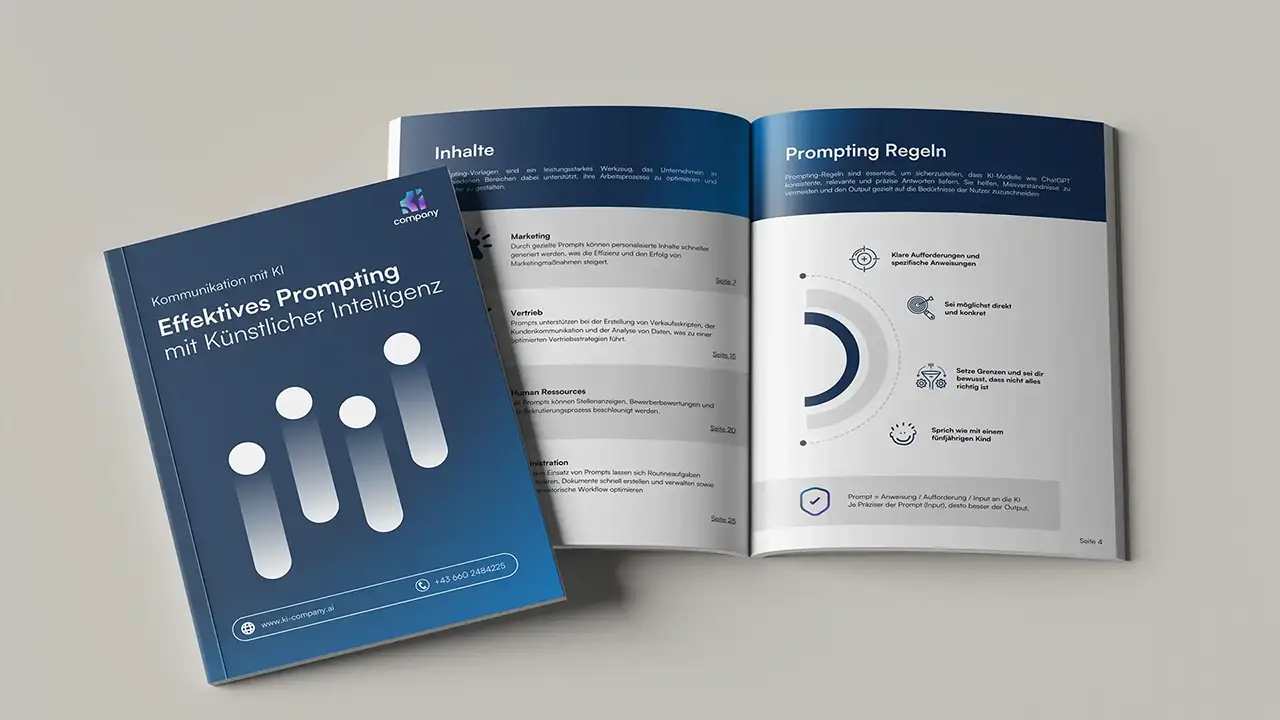
A central component is prompting. Participants learn how to formulate clear work instructions. Good prompts include the goal, context, desired format, target audience, and quality criteria.
A simple prompt is: "Write an email." A much better prompt is: "Draft a friendly, professional response to a customer asking about the status of their quote. The response should be brief, show understanding, and mention a concrete next step."
The difference is decisive. Those who prompt better get better results. This immediately increases the practical benefit.
Participants also learn to verify AI results. They understand that while AI can write persuasively, it is not automatically correct. Facts, figures, legal statements, and sensitive customer content must still be checked.
Further learning content can include:
- AI fundamentals explained clearly
- Opportunities and limitations of AI
- Secure use within the company
- Data protection and sensitive data
- Practical prompts for daily work
- AI applications for communication and organization
- AI for process improvement
- Developing custom use cases
- Next steps for team implementation
Examples of efficient workflows
An AI seminar is most effective when it focuses on concrete workflows. This helps participants quickly identify where AI can assist them in their daily tasks.
One example is meeting follow-up. Many teams spend a lot of time sorting through notes, extracting tasks, and writing summaries. AI can generate a structured overview from notes or transcripts, which the team then reviews and supplements as needed.
Another example is email communication. AI can help summarize long threads, draft responses, or adjust the tone of messages. This saves significant time, especially in customer service, sales, and project management.
AI can also support internal research. Instead of spending time searching through documents, old presentations, or knowledge bases, an AI assistant can make relevant information accessible much faster. Naturally, this requires the underlying information to be accurate and well-structured.
In marketing, AI can prepare topic ideas, content structures, campaign drafts, and SEO briefings. In HR, it can assist with job postings, onboarding documents, or internal communication drafts. In sales, it can help with meeting preparation, proposal structures, and follow-up messages.
These examples show that an AI seminar is not just an isolated training session. It can be the starting point for noticeably improving many small workflows.
Why leadership plays a key role
For an AI seminar to have a lasting impact, leadership must be involved. They set the framework, allocate time for learning, and decide which processes to prioritize.
If leaders demand AI adoption in general terms without setting clear goals, it creates uncertainty. Teams are then left unsure whether AI is truly encouraged, which tools are permitted, or how much experimentation is acceptable.
An AI seminar can help leaders develop a clear stance. They learn to view AI not just as a tool, but as a fundamental shift in how work is done.
It is also important for leaders to build their own practical competence. Those who delegate AI solely to IT or a few power users lose the strategic perspective. Leadership should understand which use cases make sense, what risks exist, and how to motivate their teams.
In the 2025 Work Trend Index, Microsoft describes how work is increasingly being reorganized through AI and human collaboration, requiring leaders to develop new work models (Microsoft).
How to get started the right way
An AI seminar should not remain too general. The best approach is to clarify the company's goals beforehand.
Does the company want to raise general awareness among employees? Is the focus on more efficient processes? Should a specific tool like ChatGPT or Microsoft Copilot be used? Or should concrete use cases be developed for specific departments?
The clearer the goal, the more effective the seminar. A good format can be implemented as a compact introduction, a half-day practical workshop, a full-day seminar, or a multi-stage training program.
For many companies, a combination makes sense. First, employees receive an understandable introduction. This is followed by practical exercises using real tasks. Finally, concrete use cases are collected and prioritized.
This creates a direct transfer to everyday work. Participants leave the seminar not just with new knowledge, but with concrete ideas, prompts, and next steps.
AI Seminars: What Companies Should Look For
An AI seminar should be practical, understandable, and relevant to the target audience. Pure theory is not enough. At the same time, the seminar should not consist solely of tool demos.
Balance is key. Participants need fundamentals, concrete exercises, clear rules, and room for questions. This is the only way to build trust.
Companies should also ensure that data protection and responsible use are addressed. Employees need to know which data they are allowed to use, which tools are approved, and when human review is necessary.
Follow-up is also important. An AI seminar can generate a lot of motivation, but without next steps, the effect quickly fades. Internal guidelines, prompt collections, small pilot projects, or follow-up sessions are useful.
This turns a seminar into a real starting point for change.

What Results Companies Can Expect
A good AI seminar does not bring about a complete transformation overnight. However, it creates the foundation for AI to be used meaningfully within the company.
In the short term, employees gain confidence and motivation. They understand how AI works, where it can help, and what they need to watch out for.
In the medium term, more efficient workflows emerge. Teams use AI for recurring tasks, structure information faster, and reduce manual work.
In the long term, an AI seminar can help build a stronger AI culture within the company. Employees think more in terms of processes, recognize automation potential, and develop their own ideas for improvements.
The most important effect is often not just time savings. A new understanding emerges of how work can be better organized with AI.
Conclusion for Companies: AI Seminars
An AI seminar is a sensible step for companies if the goal is to motivate teams and make processes more efficient. It combines orientation, practical application, and a readiness for change.
It is crucial that employees are not left alone with AI tools. They need understandable explanations, concrete examples, secure guidelines, and space to experiment.
Those who introduce AI correctly reduce uncertainty and create acceptance. Teams realize that AI is not working against them, but can support them with recurring and time-consuming tasks.
The KI Company offers exactly these types of AI seminars for businesses. We provide your teams with practical insights into how AI can be integrated into daily work, how to make processes more efficient, and how employees can use AI safely and with confidence.
If you are looking to introduce AI effectively, empower your teams, or develop initial use cases within your company, the KI Company is happy to support you with a tailored AI seminar. Together, we will create an accessible, secure, and practical path toward the productive use of AI.
AI Seminar: Frequently Asked Questions
What is an AI seminar?
An AI seminar is a practical training session for companies that want to empower their employees to work with artificial intelligence. It covers the fundamentals, potential applications, secure usage, and concrete examples for everyday work tasks.
Who is an AI seminar for?
An AI seminar is suitable for managers, employees, project teams, marketing, sales, HR, administration, customer service, IT, and any department looking to streamline their processes. Prior knowledge is generally not required for an introductory seminar.
What do employees learn in an AI seminar?
Employees learn how AI works, which tasks are suitable for it, how to write effective prompts, and how to verify AI-generated results. The training also covers data protection, responsible usage, and specific use cases relevant to their own work areas.
How does an AI seminar motivate teams?
An AI seminar motivates teams by explaining AI in clear terms and demonstrating exactly how it can make daily work easier. When employees see firsthand that AI can complete specific tasks faster or more easily, skepticism decreases and the willingness to use the technology grows.
How does an AI seminar help make processes more efficient?
An AI seminar demonstrates which recurring tasks can be supported by AI. This includes emails, meeting summaries, research, document creation, reporting, customer communication, and internal coordination.
How long does an AI seminar last?
An AI seminar can be delivered as a compact introduction, a half-day workshop, a full-day seminar, or a multi-stage program. The ideal duration depends on the target audience, their prior knowledge, and the desired depth of the training.
Why is an AI seminar beneficial for companies?
An AI seminar prevents employees from using AI in an insecure, haphazard, or non-existent way. It establishes a shared understanding, clear guidelines, and practical skills, allowing companies to use AI in a more structured and productive manner.
Does the KI Company offer AI seminars for businesses?
Yes, the KI Company offers practical AI seminars for businesses. The content is customized to your specific industry, teams, and goals. This ensures that employees learn directly how to use AI safely, confidently, and efficiently in their daily work.